
Is The World Ending? Global South Queer Perspectives on Apocalypse and Alternative Futures
By Majandra Rodriguez Acha, a former Aronson Fellow and Graduate Research Assistant at the Tishman Environment and Design Center
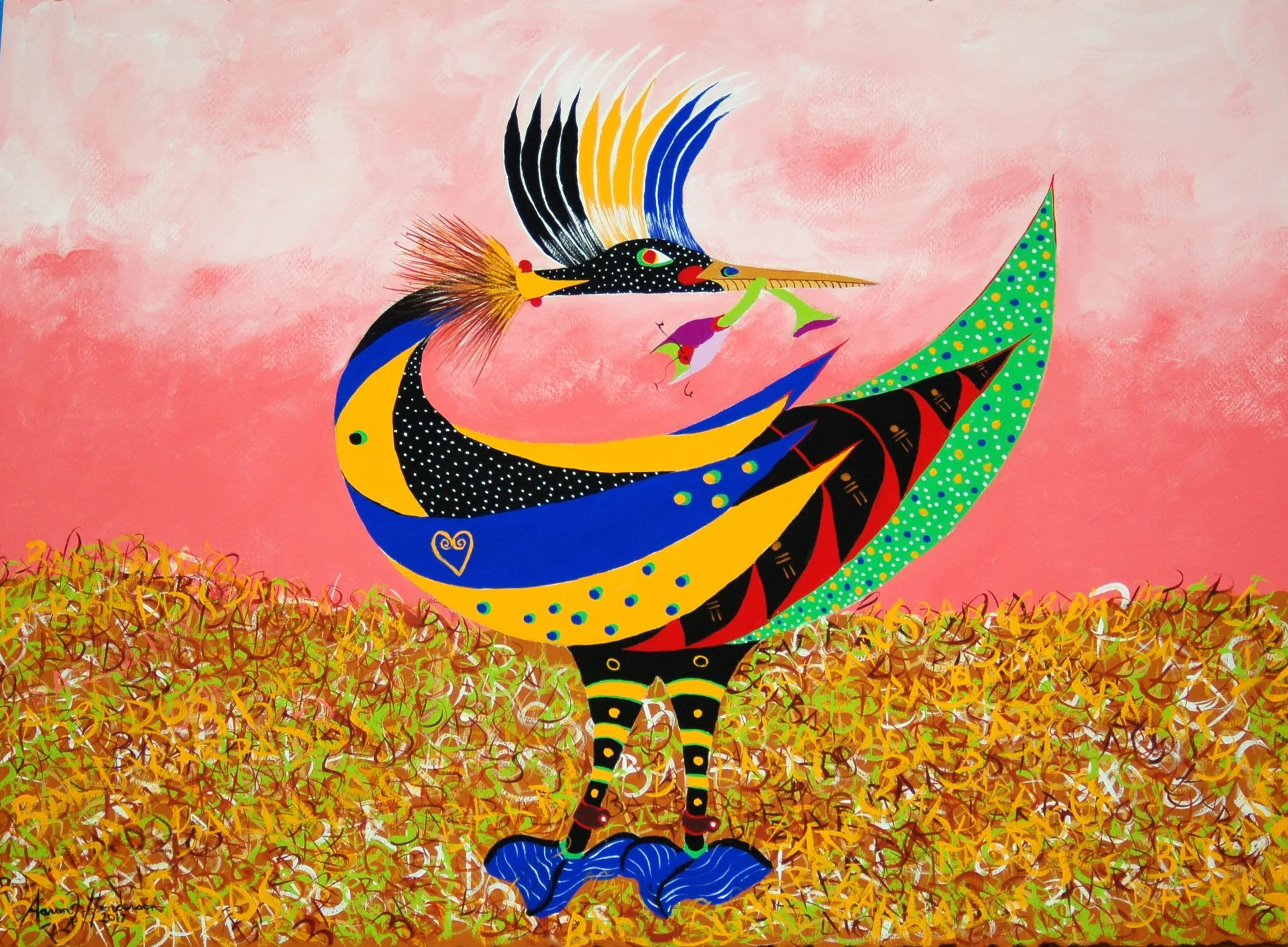
Credits: Sankofa by Aaron F. Henderson. Description: Sankofa is a word in the Akan language of Ghana meaning "to retrieve." One of the interviewees referenced it in relation to the notion of going back to the past to move forward, and the spiral nature of time.
Is the world ending? As a queer climate justice activist from Peru, I have experienced and witnessed the impacts of anxiety regarding the state of our world and rising apocalyptic narratives on myself and my communities. Narratives of the “end of the world” can be seen as a means of processing and making sense of this age of polycrises. Yet they also have tangible impacts in the here and now.
The climate emergency is just one aspect of our current age of multiple and intersecting crises, which is marked by heightening inequalities, rising fundamentalisms and closing civic space, the ongoing exploitation of nature, transgressed planetary boundaries, deepening conflict, and more. This global scenario profoundly impacts our very understandings of life and death, as well as our hopes and fears for the future – not just regarding our own survival, but that of our very world(s).
In this context, political-economic elites are simultaneously provoking, profiting from, and obsessively planning for doomsday scenarios. This apocalyptic nihilism is fueling bunker-building, artificial intelligence-accelerating, space-exploring endeavors bankrolled by the world’s richest men. As these ventures fast-track harm for people and the planet, who they intend to ultimately ‘save’ from doom are arguably not the majority of the world, but rather a privileged minority: political-economic elites themselves.
Indeed, many of their actions are explicitly rooted in the belief in an endgame scenario in which a ‘chosen’ few are to transcend, while most perish. As Klein and Taylor argue in their forthcoming book End Times Fascism, this apocalyptic paradigm is a final refuge for those who find it easier to celebrate destruction than imagine living without supremacy.
In the context of rising apocalyptic paradigms held by Global North-based elites, my research looks to center the perspectives held by diverse Global South, queer climate justice activists: how they (we) understand the future, the so-called end of the world, and time itself. In April 2026, I carried out initial interviews with Black and Indigenous Global South queer climate justice activists from Kenya, Mexico, and Brazil, asking: What do Global South queer climate activists envision for the future(s)? And what might it mean to decolonize and queer our future(s)?
As apocalyptic paradigms attempt to curtail the collective imagination, presuming that it is easier to imagine the end of the world than the end of capitalism and supremacy, doomsday narratives have become increasingly mainstreamed. Simultaneously, however, alternative paradigms regarding the ends and beginnings of worlds are being continuously created, remembered and (re)built by diverse communities and social movements across the globe. These include approaches that contest the ‘end of the world’ as an inevitable progression towards either ultimate demise or (White, cis male, elite) triumph over nature; understandings of time that blend past, present and future in non-linear ways, and approaches situated in uncertainty and spaces of possibility –what Lola Olufemi calls the otherwise.
Grounded not in false optimism but rather a deep understanding of reality, these paradigms recognize that very real ends-of-worlds have already occurred and are continually occurring amidst ecosystem collapse, enduring colonialism, warfare and more. Simultaneously, worlds and expanding horizons are continually being imagined, (re)created and (re)built. Black, Indigenous and People of Color futurisms transcend notions of both a singular future as well as a singular world. Here, “the” end of “the” world loses meaning. Similarly, queer futurities disrupt straight timelines, and embrace alternative possibilities for collective life together.
These alternative paradigms center the potential of ancestral futures, of repair amidst irreconcilable loss, and of new realities that can emerge after not the end of the world, but rather the end of the world as we know it: that is, the end of an unsustainable mode of living premised on dispossession.
The conversations I held with Global South queer climate activists highlighted their clarity regarding the extent of the environmental and social devastation we are facing and will face, as well as a sharp vision and grounding in what they desire and are fighting for. The activists I spoke with are neither naively optimistic nor pessimistic. Rather, they are grounded in both recognition of profound past, present, and future harm, as well as in deep care and enduring hope for human and more-than-human communities. They hold openness to the uncertainty of the future, as well as a belief that other worlds are possible, and necessary.
Importantly, the activists interviewed perceive time as relational, plural, mobile, and non-linear: the past is not in the past, the present is not in the present, the future is not in the future. This is deeply intertwined with what it means to decolonize and queer the future. Ultimately, time is not fixed: it can be molded and intervened in.
If apocalyptic narratives are a self-fulfilling prophecy, what does it take to break the prophecy? What does it take to liberate our imaginations from the end of the world? Apocalypse narratives excuse us from acting, because they assume the future is predetermined. In that sense, rupturing the apocalypse means doing away with control and certainty. It means humbly accepting that we don’t know, and can’t know, the future. And ultimately, in uncertainty lies hope and room to act. Not naïve hope, but hope arising from possibility, agency, responsibility and action. While doomsday narratives constitute a powerful and consequential imagination of their own, radical imaginations and subaltern futurities open vital possibilities. They support us to embrace the possibility of plural futures and worlds in which reconnection with all life and care, relations and community are at the center – and encourage us to engage in the collective self-determination of our futures.
With deep gratitude to interviewees Hellen Freitas, José Villalobos and Winny Ouma.
Key sources
Indigenous Action. (2020, March 19). Rethinking the Apocalypse: An Indigenous Anti-Futurist Manifesto. https://www.indigenousaction.org/rethinking-the-apocalypse-an-indigenous-anti-futurist-manifesto/
Klein, N., & Taylor, A. (2025, April 13). The rise of end times fascism. The Guardian. https://www.theguardian.com/us-news/ng-interactive/2025/apr/13/end-times-fascism-far-right-trump-musk
Mitchell, A., & Chaudhury, A. (2020). Worlding beyond ‘the’ ‘end’ of ‘the world’: White apocalyptic visions and BIPOC futurisms. International Relations, 34(3), 309–332. https://doi.org/10.1177/0047117820948936
Robson, A. (2025). Troubling times: Climate crisis, future geographies and queer theory. Progress in Environmental Geography, 4(3), 298–319. https://doi.org/10.1177/27539687251355273
Spice, A. (2024). Queer (Re)generations: Disrupting Apocalypse Time. In M. D. Weiss (Ed.), Unsettling queer anthropology: Foundations, reorientations, and departures. Duke University Press.
Whyte, K. P. (2018). Indigenous science (fiction) for the Anthropocene: Ancestral dystopias and fantasies of climate change crises. Environment and Planning E: Nature and Space, 1(1–2), 224–242. https://doi.org/10.1177/2514848618777621
Photo of Majandra by Mike Harrington
Majandra Rodriguez Acha is a former Aronson Fellow and Graduate Research Assistant at the Tishman Environment and Design Center. She graduated with honors in Spring 2026 from the Environmental Policy and Sustainability Management (EPSM) MS at The New School. The following is an overview of her capstone research, carried out with support from Dr. Ana Baptista, lead faculty of the EPSM program. The Women’s Environment and Development Organization (WEDO), of which Majandra is a former Young Fellow, provided support by connecting Majandra to interviewees for this research.