
From Power Lines to People Power: A Community Guide for Transmission Projects

Dr. Jennifer Ventrella
Research Associate, Tishman Environment and Design Center
“Decisions about electric transmission can be complex and difficult to participate in, but they have real impacts on communities. This guide is intended to be an accessible resource, highlighting key decision points where advocacy groups can influence decision-making. Meaningful community participation is critical to ensure that clean energy transitions benefit environmental justice communities who have disproportionately faced the burdens of our electricity system. By connecting research, policy, and action, this guide supports the Tishman Center’s mission to advance climate justice and serves as a practical tool for shaping a more equitable energy future.”
-Dr. Jennifer Ventrella
Tishman Center’s Student Spotlight:
Dr. Jennifer Ventrella recently earned her PhD in the Public and Urban Policy program at The New School while working as a research associate at the Tishman Center. Her dissertation, developed under the guidance of Dr. Ana Baptista, focuses on environmental justice and electric transmission. With support from the Tishman Center, Jen adapted her research into this practical guide as a resource for communities to engage in decisions about transmission lines and the power grid.

Electric transmission lines, which can run hundreds or even thousands of miles long, are essential to bring new renewable energy onto the power grid and shut down fossil fuel power plants, something low-income communities and communities of color, or environmental justice (EJ) communities, have long called for. But transmission projects can also introduce new risks that must be carefully considered to ensure a just transition away from a fossil fuel-based economy towards renewable energy. Therefore, more democratic and transparent practices are crucial to bring benefits to communities.
WHY ARE TRANSMISSION LINES IMPORTANT?
Electric transmission lines are essential to bring new renewable energy onto the power grid and phase out fossil fuels, something low-income communities and communities of color, or environmental justice (EJ) communities, have long called for. But transmission projects can also introduce new risks that must be carefully considered to ensure a just transition away from a fossil fuel-based economy towards renewable energy.
Transmission lines can span hundreds or even thousands of miles, cutting through neighborhoods, farmlands, forests, and Tribal territories. The process to develop these lines is complex and opaque, and one of the reasons for delays comes from a lack of information about how the system works and where key decision points are that can help inform development. More democratic and transparent practices are crucial to bring benefits to communities.
That’s why it’s important to define key areas of transmission decision-making and ask critical questions: Where is the line being sited? Who owns it? Who benefits from it? And who is left out or is burdened by it?
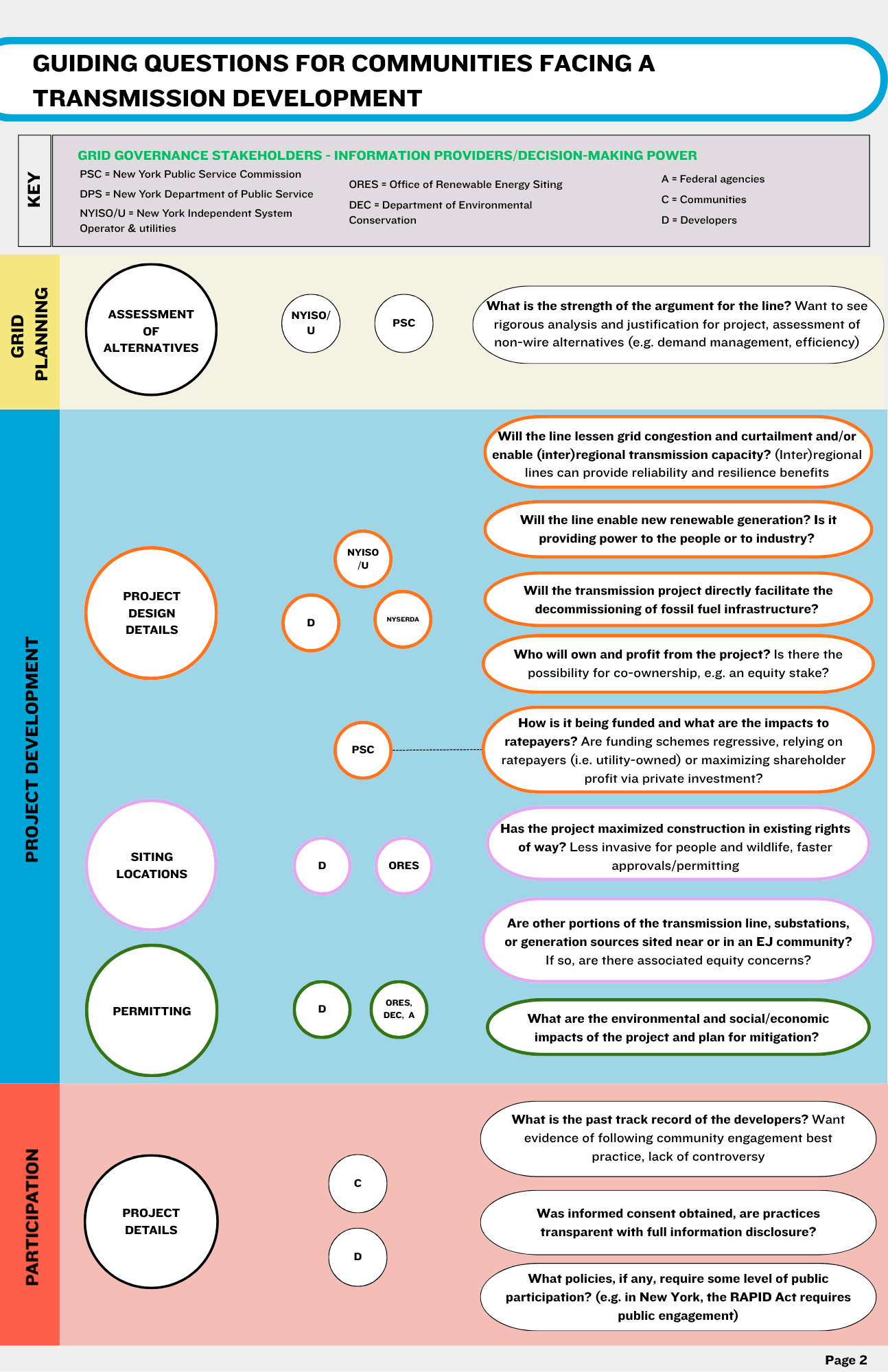
This guide examines these questions through the example of New York, a state that has recently made a big push to develop more transmission infrastructure to upgrade the power grid and meet its landmark climate law, the 2019 Climate Leadership and Community Protection Act (CLCPA). It offers a set of questions to help communities assess the potential benefits and risks of a transmission project, from early planning through design and permitting to how communities can engage. It also identifies which grid stakeholders (shown by circle icons) might have the information you need and critical decision points where you can influence outcomes, with a focus on the state and local levels. This guide is intended as a resource and starting point for communities and community groups to evaluate projects, consider how they might be shaped to better reflect local priorities, and influence decisions.
HOW TO USE THIS GUIDE
Influencing Decisions: Transmission Development Process (Page 1)
Understanding the key points along the process, from planning to permitting, where your input can make the biggest difference, is critical. Use this information to make specific asks of the project developers or other key players, like pushing for changes to the design or siting locations.
By identifying informal and formal opportunities to influence the decision-making process, this guide can help shape decision-making and inform discussions of how your community ultimately supports, engages with, or opposes each project.
Guiding Questions for Communities Facing a Transmission Development (Page 2)
Start by using the list of questions to explore and identify top priorities for your community in relation to the transmission project (for example, “Our top priority is bringing in new renewables”).
The circles in the diagram show which stakeholders might have information about the transmission line project or have decision-making power along the different phases of the project’s approval. These stakeholders and agencies may be useful starting points for your engagement. They are also important players who can be part of advocacy efforts to ensure community concerns are addressed.

Other Resources
Mike Harrington, Director of Sustainability Engagement at the Tishman Environment and Design Center, sits down with Jen Ventrella to discuss a guide she developed as part of her dissertation research to serve as a resource for communities facing a transmission development in their neighborhood. The guide, shared below, can be used to evaluate transmission projects, consider how they might be shaped to better reflect local priorities, and identify key intervention points to influence planning decisions.
See these publications for an overview of justice and the power grid and some of the barriers stopping new renewables from connecting to the grid.