
POV: Environmental Justice, Feminism, and Indigenous Voices at Climate Week NYC
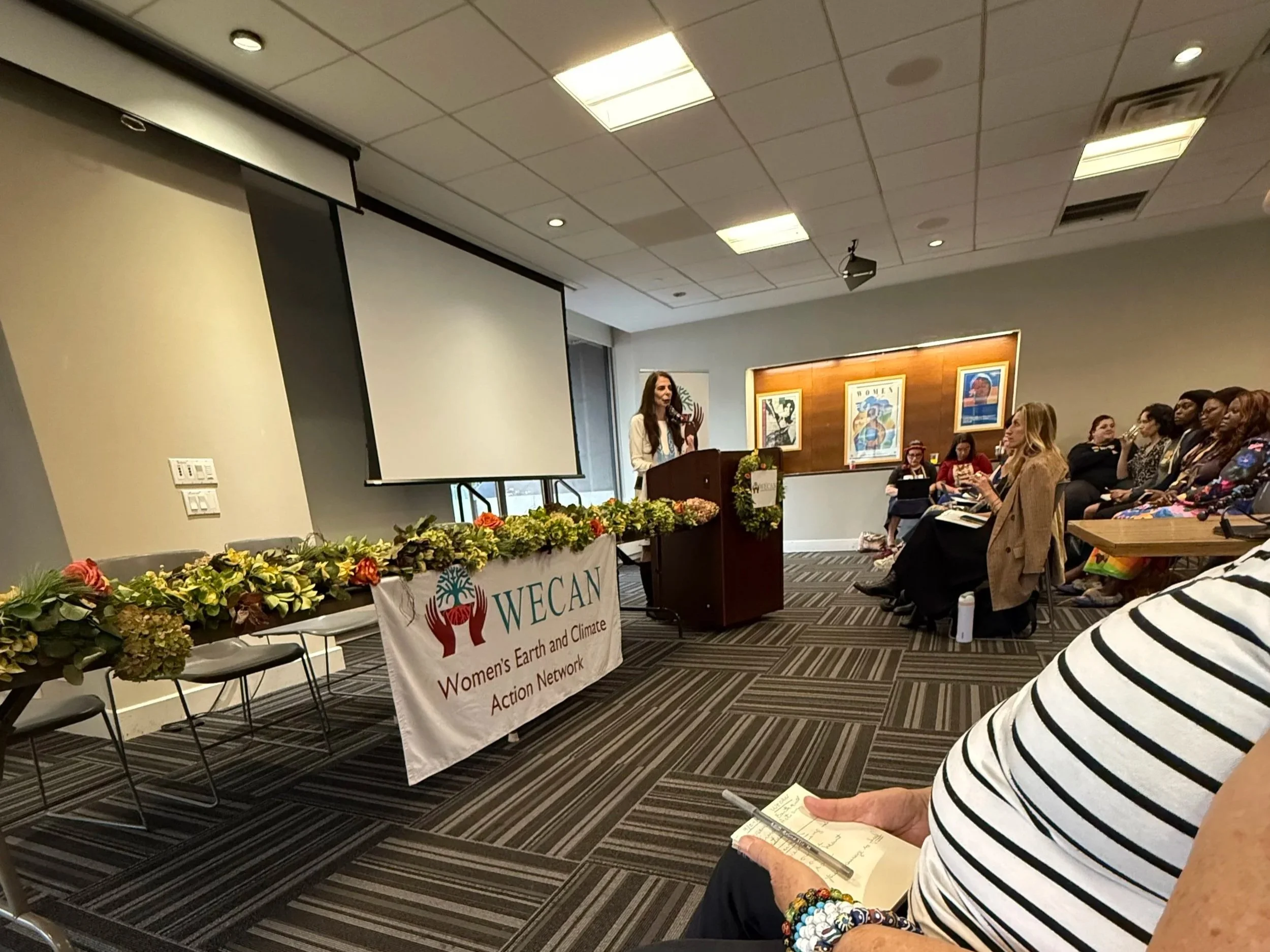
Osprey Orielle Lake, Founder and Executive Director, Women's Earth and Climate Action Network (WECAN) International at the WECAN Women in Action for Climate Justice and Just Transition: Path to COP30 and Beyond
Dear Reader,
Imagine you are a young minority woman living in the most expensive city in the United States (New York City), and Mayor Mamdani just won! You grew up in the Hudson Valley, but now work two jobs while simultaneously navigating your senior year at Parsons to complete an MS in Strategic Design and Management. Put yourself in those shoes — my shoes — and paint a picture to contemplate what the future may look like. Do you see a city bustling with character, surrounded by lush lands, with ecosystems of people, plants, and animals, living in peace and prosperity? Do you share my hope for biodiversity and an ethical community of care? If so, then our sociopolitical ideals align, and you, too, may have chosen to become a Research Associate for the Tishman Environment and Design Center this fall. You may have also admired the Tishman Center this year, on the eve of its 20th anniversary, for its commitment to uplifting Environmental Justice (EJ) voices. The Center builds critical movement power and capacity for long-term wins, which is why, as a newcomer, I felt encouraged to immerse myself in our September 2025 efforts. I worked to support, attend, and document not only our own convenings but those of our partners. That being said, allow me to share the tale of my first Climate Week and an event that transcended work to remind me that inspiration lies in collaboration, and it is only then that we see the whole picture and can paint our shared dream.
The event in question was the WECAN Women in Action for Climate Justice and Just Transition: Path to COP30 and Beyond, hosted at 777 United Nations Plaza, during Climate Week NYC 2025. Now, if the numerology of the address was not enough to entice you, then I am certain the EJ leaders lined up outside the doors would have surely drawn you in. In fact, the event was so well attended that many people were turned away due to fire safety occupancy laws. I soon saw how critical this precaution was as both the panel and organizers quickly set the room ablaze with their moving remarks, jarring statistics, and heated commentary on the current climate crisis and barriers to sustainable progress. If the WECAN event had been a painting, it would have been vivid crimson, it would have had the spiritual touches of gleaming gold used by Klimt, and the authentic power of Frida Kahlo. The surreal, hopeful energy in the room was reminiscent of Dalí, and I was a starstruck museum goer trying her best to absorb the lessons of mastery before nightfall.

I felt nothing short of inspired. The members of WECAN graciously uplifted our Keynote event days prior, and as a recent UN Intern, I felt it was only natural to revisit my old stomping grounds and show support for this amazing group of environmental advocates. Their event gathered a powerful coalition of global leaders and changemakers who called for an end to extractive systems that have long driven both ecological destruction and social injustice. Thilmeeza Hussain, Director at the United Nations Regional Commissions, denounced climate "sacrifice zones” like her home country, the Maldives, reminding attendees that any “systems of extraction, fossil fuels to now minerals,” continue to exploit both people and the planet. Speakers such as Jozileia Kaingang of ANMIGA and Casey Camp-Horinek of the Ponca Nation emphasized that any transition must be just and fair, centering Indigenous knowledge and gender justice rather than perpetuating these extractive economies. They highlighted how Indigenous peoples have always been innovators, creating technologies such as aspirin and rubber long before colonization, only to see these inventions taken, patented, and sold without recognition or consent. As moderator Osprey Orielle Lake underscored, sustainability and justice are inseparable: to restore the Earth, humanity must also restore balance and respect for those who have long protected it.
Speakers, including Colette Pichon-Battle of Taproot Earth, Tzeporah Berman of the Fossil Fuel Non-Proliferation Treaty, and Jacqueline Patterson of The Chisholm Legacy Project, wove together urgent calls for systemic transformation. They reminded the audience that “the earth is not dying, it is being killed,” and that ecological collapse is not inevitable but the outcome of deliberate political and economic decisions. The recent ICJ ruling in the South Pacific was celebrated as a “massive win” for accountability. The win aligned with what I had learned at the Tishman Center about long-lasting progress and goals that set precedent for future healing. Meanwhile, the mention of the Pakistan floods was framed as both a climate and feminist crisis, revealing that violence and inequality intensify under climate stress, reminding us how important and continuous the fight for gender equality must be. As the event closed, Eriel Tchekwwie Deranger, member of the Athabasca Chipewyan First Nation and winner of the Climate Breakthrough Award, called for collective resistance, where care, ethics, and solidarity intertwine to challenge corporate greenwashing and demand genuine, systemic change.
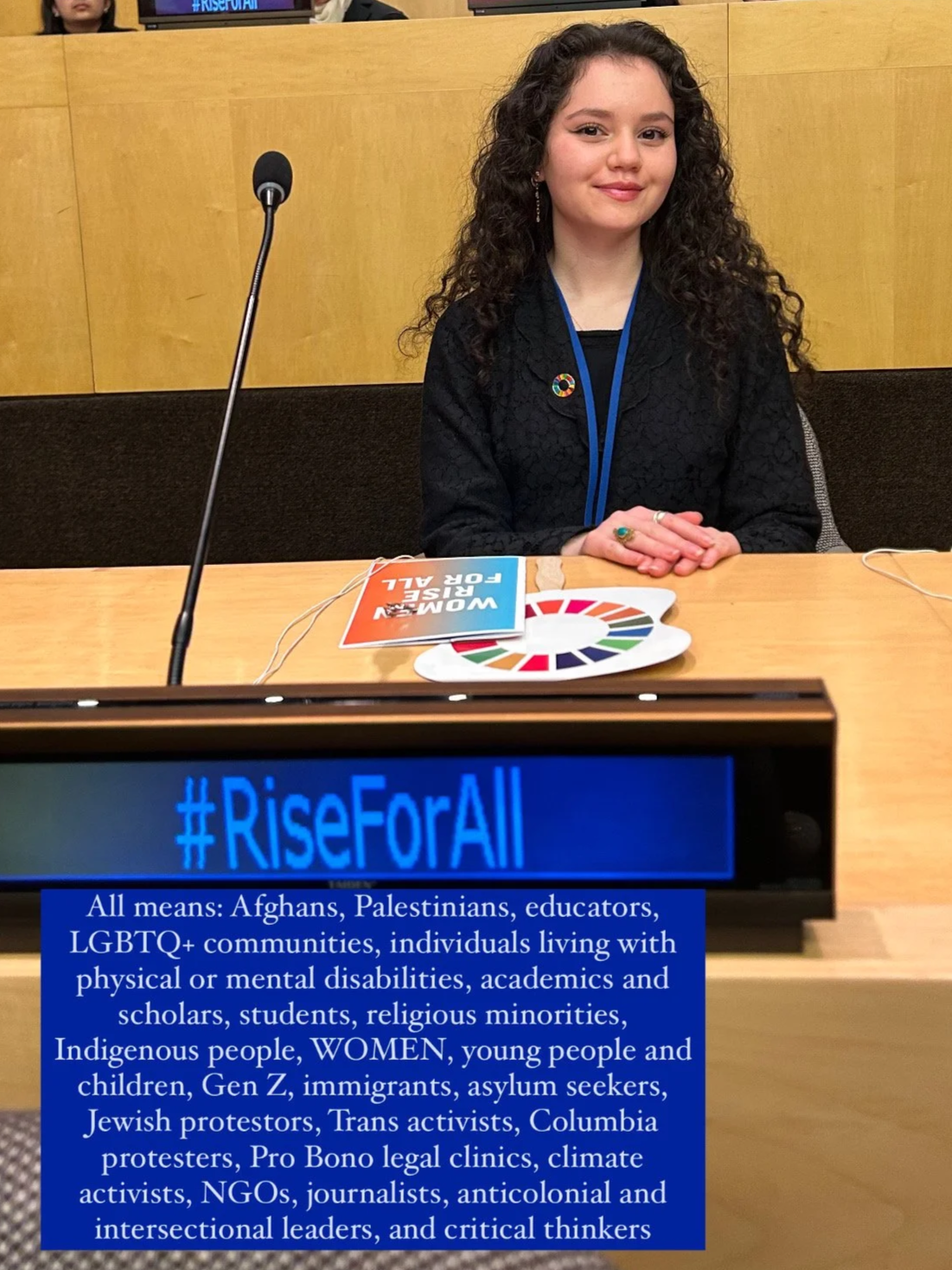
Zora Stanik, MA, International Relations and International Law at the University of Edinburgh for the Women Rise for All Commission on the Status of Women (CSW69) at the United Nations.
I was proud to independently represent the Tishman Center at this truly remarkable event, and I will never forget the words of these incredibly powerful leaders. They taught me about the power of collective action, the value of building on one another's efforts, and to strive for more equitable progress. I learned to paint the whole movement, from the roots to the leaves, to the clean skies and the buzzing bees. I learned to dream freely with native care and protection central to my palette. To be enlightened by other women on the true meaning of ‘Just Returns’ under the backdrop of the United Nations, with its diverse global flags waving side by side, was a memory I will not soon forget. I would like to extend my sincerest gratitude to the organizers of this event and to the Tishman Center for showing me the world of environmental justice, research, and meaningful advocacy with our partners. If you would like to learn more, please reach out to me on LinkedIn and be sure to subscribe to our newsletter for more interesting EJ recaps like this one!
— Zora Stanik